The legacy journey took weeks of paperwork and manual compliance checks
- Register and pay
- Wait for email instructions1 to 3 days
- Email the documents by hand
- Wait for manual review3 to 14 days
- Call support to chase status
- Register
- Instant portal access
- Complete the smart formchecked as you type
- Automated document validation
- Live status, no chasing
What applicants wanted most was to know where they stood.
One adaptive journey kept a single compliance rulebook across three account types
The client is one of the UK's largest company-formation agents: over one million companies formed, a company every eight minutes, a 140-strong team and three formation brands. It registers companies for direct clients and partner businesses, and the same portal also runs white-labelled under other companies' brands, serving their customers as their own product. I defined the three account types this needed, and three separate flows looked like the obvious build. Three flows would mean three copies of the compliance rules, drifting apart every time the regulation changes. The rules are heavy: anti-money-laundering law, Companies House requirements and GDPR. Every applicant clears identity and KYC checks. Companies bring directors and beneficial owners, each verified in turn, and a banned country or a forged document has to stop the application cold.
I decided: one system. One adaptive portal proves the rules once, against a single rulebook compliance can certify, and asks each applicant only what their case needs. The build cost is paid once. Drift would have cost at every regulation change, forever.
View my comment
The recommendation was mine. The CTO and Managing Director backed it, and the CEO signed it off.
KYC and identity verification are embedded, with a dashboard for partners
The portal works out the account type at the start, then everything after it adapts. The fields, the documents, the checks, the order. Identity verification runs through an external provider, embedded so it never reads as a handoff: I agreed the outputs with them and designed the closing screen around it, everything ticked, application complete. Face verification with clear guidance, email confirmation, and a PIN login for white-label partners, whose own customers need secure access without ever seeing the platform underneath. The partners themselves get a dashboard: every customer account, its compliance status, invites sent and tracked, all under their own branding.
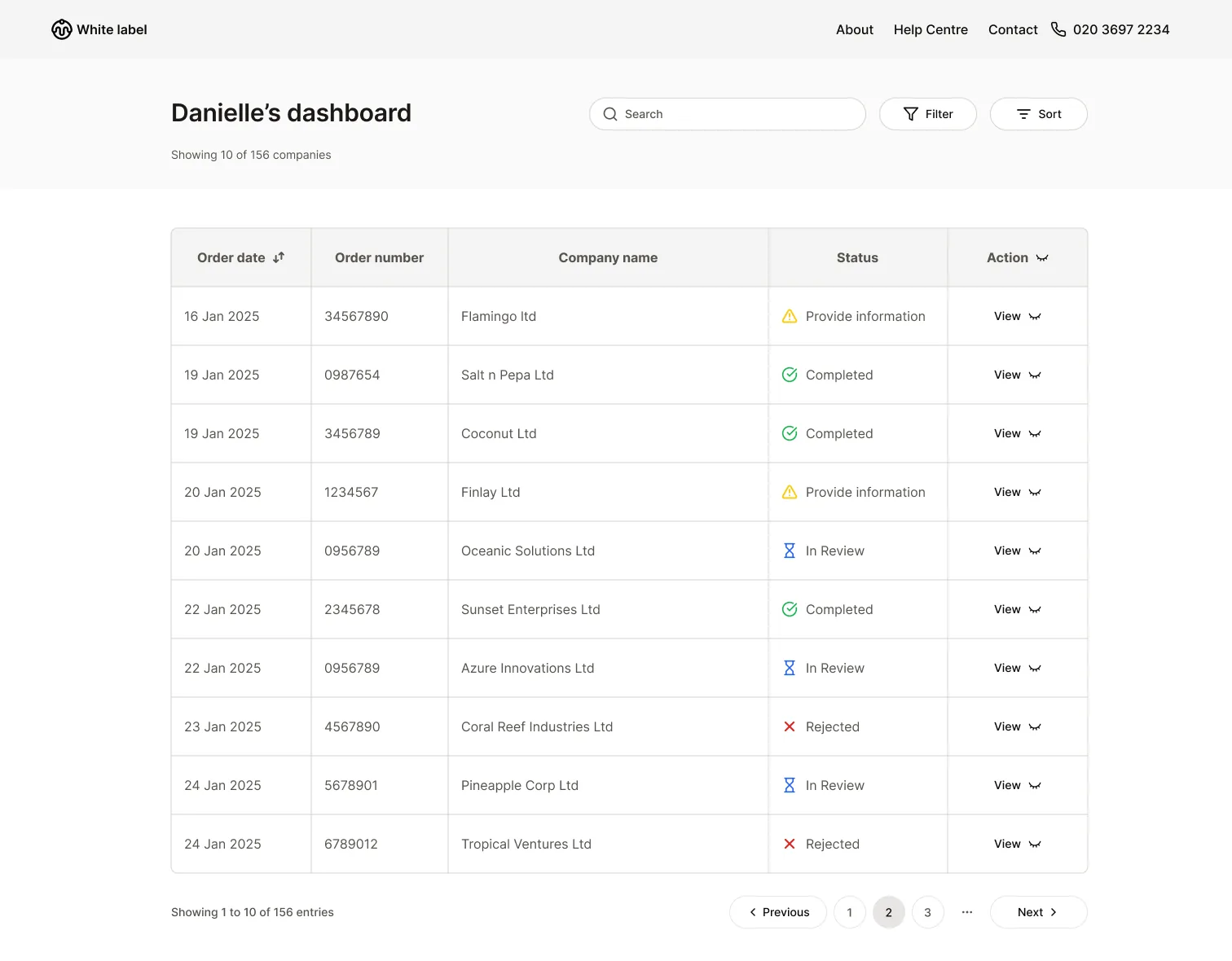
1Carol onboards herself
See it from three sides. Switch the account type and the path changes with it.
Your details
Documents required
Your application
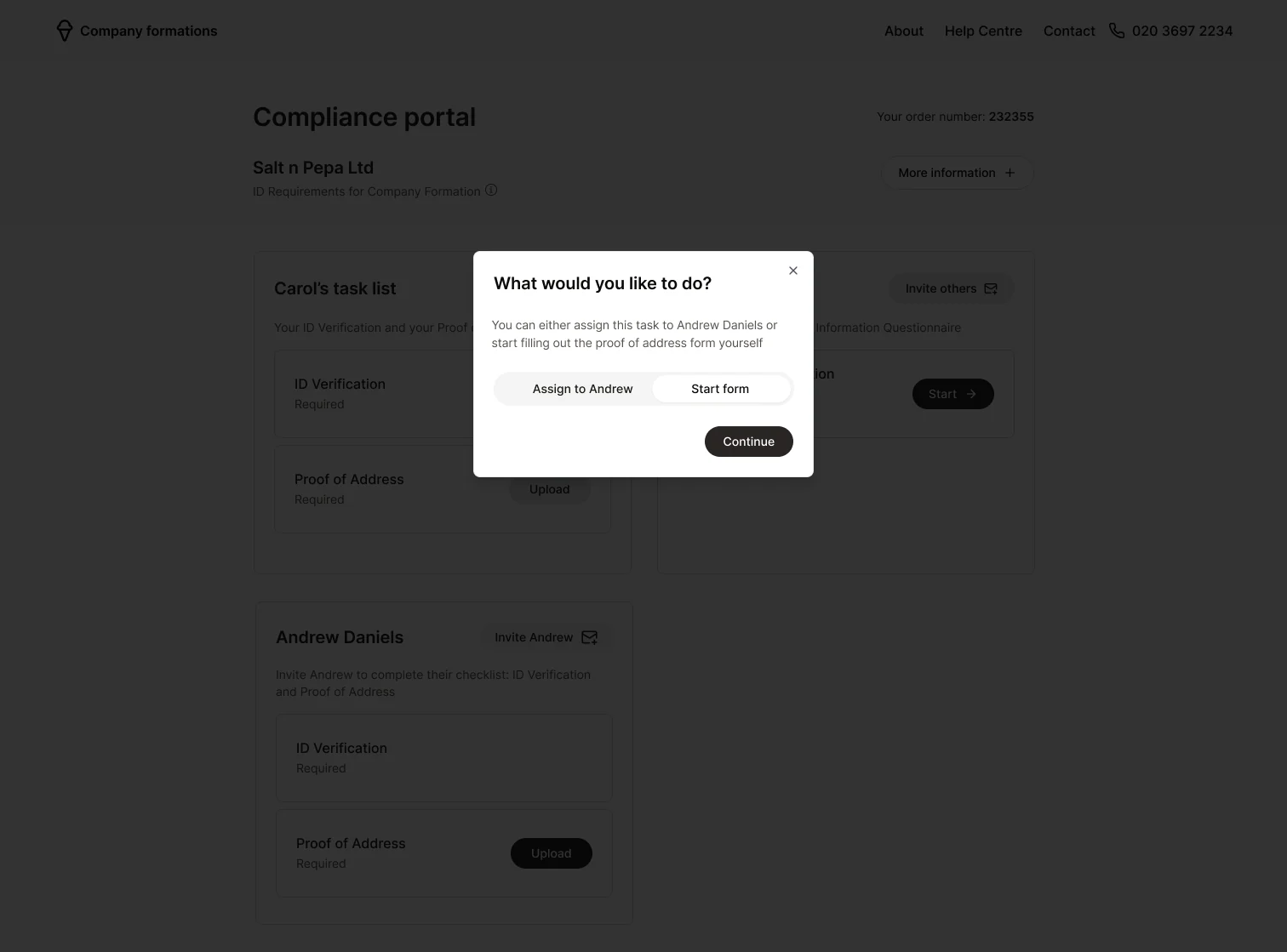
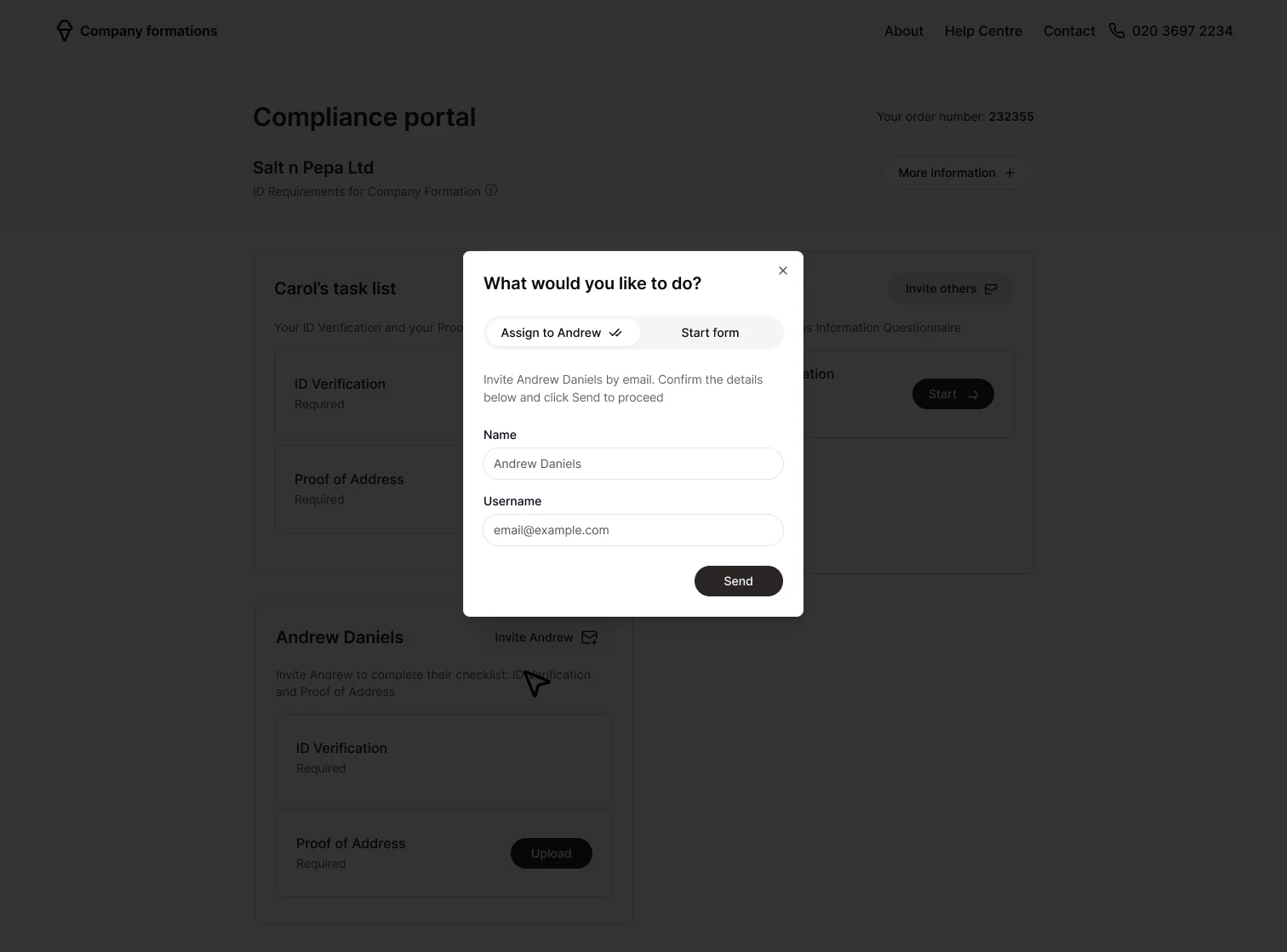
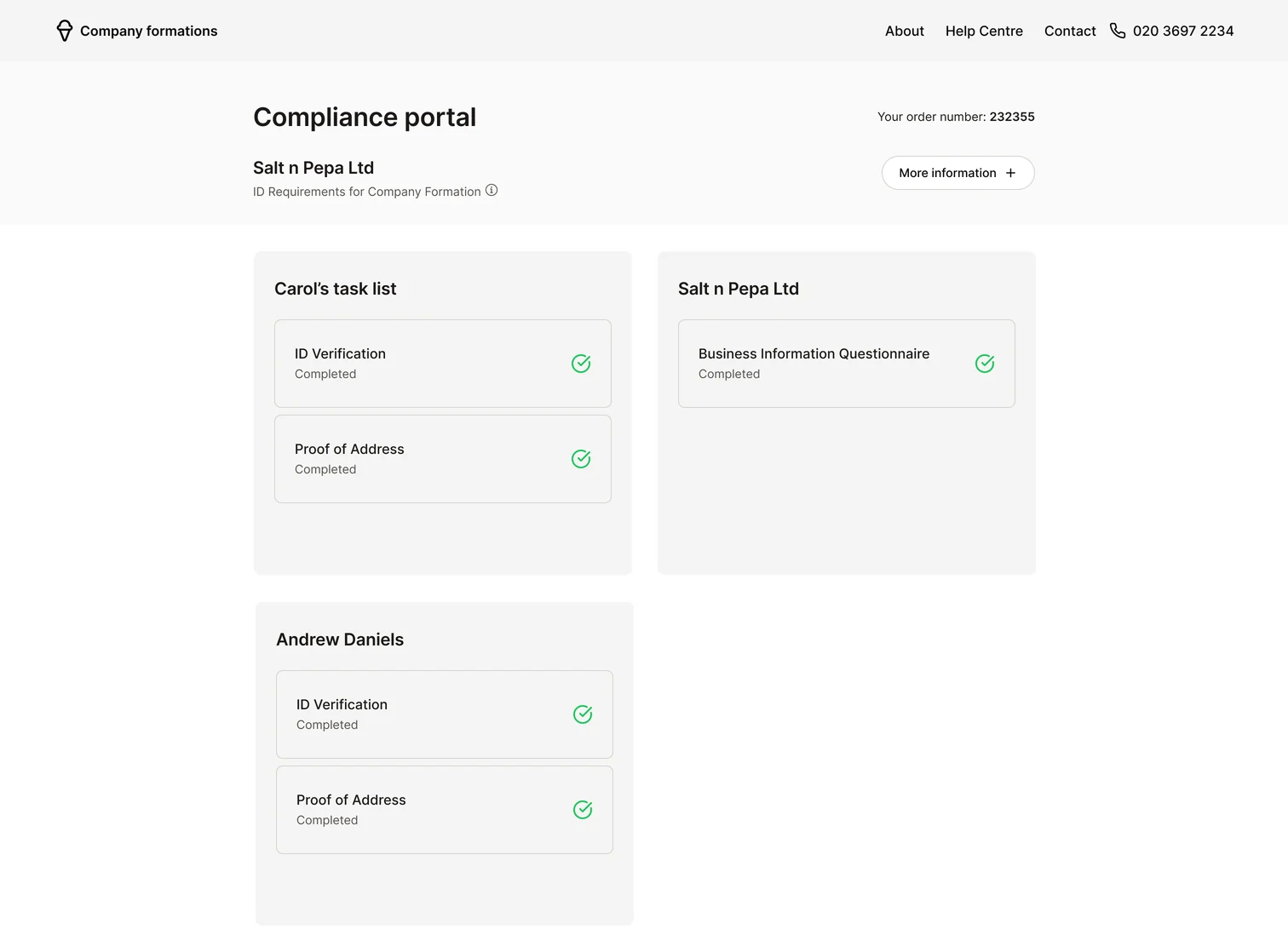
Each director verifies their own identity while the applicant keeps their place
Regulated accounts rarely belong to one person. A company has directors, and each has to be verified. The portal lets the applicant bring the others in and keep their place.
View my comment
The best backend discussion was about coming back. The platform belongs to the white-label brand, so applicants never create an account. Their application lives behind an emailed link, one click back to the live checklist, nothing to remember, nothing to reset. An invited director arrives the same way.
2Carol invites Andrew
Journey mapping and A/B tests put live status at the centre
One research finding shaped the whole interface. Applicants wanted to see what was happening.
I mapped the end-to-end journey and ran A/B tests. Four pain points came up every time. Applicants did not know which documents to submit, could not see their status, and waited days with no estimate. Behind the scenes, 14 people kept the whole thing moving by hand.
The design showed the state everywhere. Guidance at each step, errors caught as you type in plain language, and live status with notifications in place of the email chase. In testing, more applicants finished when problems surfaced at entry.
View my comment
Applicants were in the dark. Everyone had read the problem as too much effort, and the research pointed somewhere else: people wanted to see what was happening and what came next. The design shows every step and every state.
Live in one month, with registration cut to hours and support calls down 71%
Registration dropped from one to three weeks to 2 to 24 hours, and support calls fell by 71%. The 14 people who had handled email by hand moved on to reviewing complete applications. The business could grow without hiring for it.
The CTO hired me for it. I owned the product strategy and the design, from a blank page to live in one month. I defined the MVP with the CTO, Managing Director and CEO and kept legal and the technical teams working to one plan. Compliance and legal signed off every flow and its wording. The design system and style guide the build ran on were mine too. The solutions architect drew the backend schema from my user-flow maps. I presented the finished product to the board myself, and left behind documentation, the design system and a trained successor designer.
One system moved the complexity from the applicant into the platform
Three account types looked like three flows. One system was the harder build and the right one, because three rulebooks drift and one holds. The design work that mattered most never reached a screen. It decided where the complexity lives: in the system, so it never lands on the applicant.